Folic acid
Key Points
Taking folic acid before and during early pregnancy can help prevent neural tube defects in your baby.
Before pregnancy, take a vitamin supplement that has 400 micrograms of folic acid in it every day.
During pregnancy, take a prenatal vitamin that has 600 micrograms of folic acid in it every day.
Take a vitamin supplement with folic acid every day, even if you’re not trying to get pregnant.
You can get folic acid from food, too. Look for fortified foods to make sure you’re getting enough.
What is folic acid?
Folic acid is a vitamin that every cell in your body needs for healthy growth and development. If you take it before pregnancy and during early pregnancy, it can help protect your baby from birth defects of the brain and spine called neural tube defects. The neural tube is the part of a developing baby that becomes the brain and spinal cord. NTDs happen in the first month of pregnancy, before you may know that you’re pregnant. This is why it’s important to have enough folic acid in your body before you get pregnant.
NTDs affect about 3,000 pregnancies each year in the United States. If all women take 400 micrograms (also called mcg) of folic acid every day before getting pregnant and during early pregnancy, it may help prevent up to 7 in 10 (70 percent) NTDs. Because nearly half of all pregnancies in the United States are unplanned, all women who can get pregnant should take folic acid every day.
Some studies show that folic acid also may help prevent birth defects in a baby’s mouth called cleft lip and palate. A cleft lip is a birth defect in which a baby’s upper lip doesn’t form completely and has an opening in it.
How can you get enough folic acid?
There are several ways to get enough folic acid:
- Taking a vitamin that has folic acid in it
- Eating foods with folate from a varied diet
- Eating fortified foods
- Getting a combination of the two: taking a vitamin that has folic acid in it and eating fortified foods
How much folic acid do you need?
Here’s what you need to know about taking folic acid to prevent NTDs:
Most women
To help prevent NTDs in your baby, take a vitamin supplement with 400 mcg of folic acid every day before you get pregnant. A supplement is a product you take to make up for certain nutrients that you don’t get enough of in the foods you eat. Start taking 400 mcg of folic acid each day at least 1 month before pregnancy through the first 12 weeks of pregnancy. Your folic acid supplement can be:
- A multivitamin. This is a pill that contains many vitamins and other nutrients that help your body stay healthy.
- A prenatal vitamin. This is a multivitamin made for pregnant women. Your health care provider may give you a prescription for prenatal vitamins, or you can get them over the counter without a prescription.
- A supplement that contains just folic acid
Take a vitamin supplement with 400 mcg of folic acid each day, even if you’re not trying to get pregnant.
During pregnancy, take a prenatal vitamin each day that has 600 mcg of folic acid in it. Folic acid only works to prevent NTDs before and during the first few weeks of pregnancy. Later in pregnancy, you need 600 mcg of folic acid each day to help your baby grow and develop.
Women at high risk for NTDs
If you’re at high risk for having a baby with an NTD, take 4,000 mcg of folic acid each day to help prevent an NTD. Start taking 4,000 mcg of folic acid 3 months before you get pregnant through 12 weeks of pregnancy. You’re at high risk if:
- You’ve had a baby with an NTD in the past.
- You or your partner has an NTD.
- Your partner has a child with an NTD.
Studies show that taking 4,000 mcg of folic acid before and during early pregnancy can help reduce your risk of having another baby with an NTD by about 70 percent. Ask your provider how to safely get this much folic acid. It’s not safe to take several multivitamins or prenatal vitamins because you can get too much of other nutrients, which may be harmful to your health. Your provider can help you figure out the best and safest way for you to get the right amount of folic acid.
How can you get folic acid from food?
You can get folic acid from food. Some foods are fortified with folic acid. Fortified means a food has folic acid added to it. Check the product label to see how much folic acid you get in each serving. Look for the word “fortified” or “enriched” on labels on foods like:
- Bread
- Breakfast cereal
- Cornmeal
- Flour
- Pasta
- Products made from a kind of flour called corn masa, like tortillas, tortilla chips, taco shells, tamales and pupusas
- White rice
Some fruits and vegetables are good sources of folic acid. When folic acid is found naturally in food it’s called folate. Foods that are good sources of folate are:
- Beans, like lentils, pinto beans and black beans
- Leafy green vegetables, like spinach and Romaine lettuce
- Asparagus
- Broccoli
- Peanuts (But don’t eat them if you have a peanut allergy.)
- Citrus fruits, like oranges and grapefruit
- Orange juice (100 percent juice is best. This means one serving of juice is equal to one serving of fruit.)
It’s hard to get all of the folic acid you need from food. Even if you eat foods that have folic acid in them, take your vitamin supplement each day, too.
How do you read a product label to see how much folic acid is in a vitamin supplement?
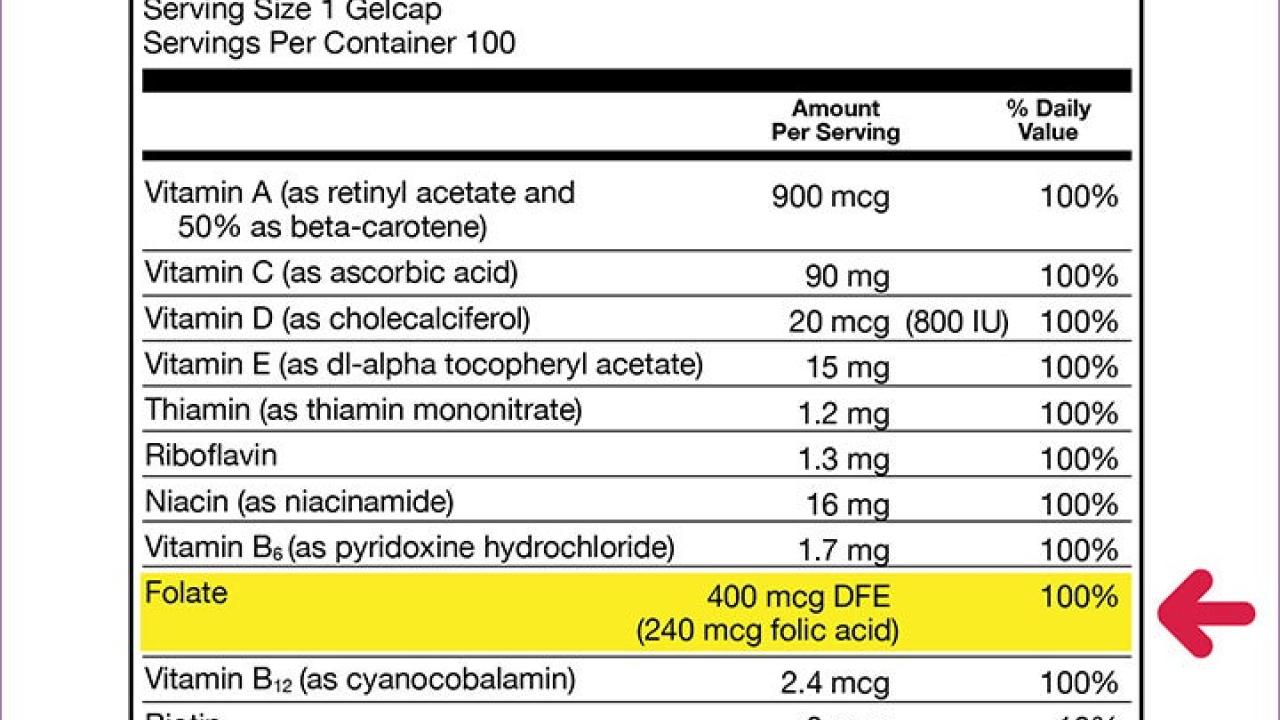
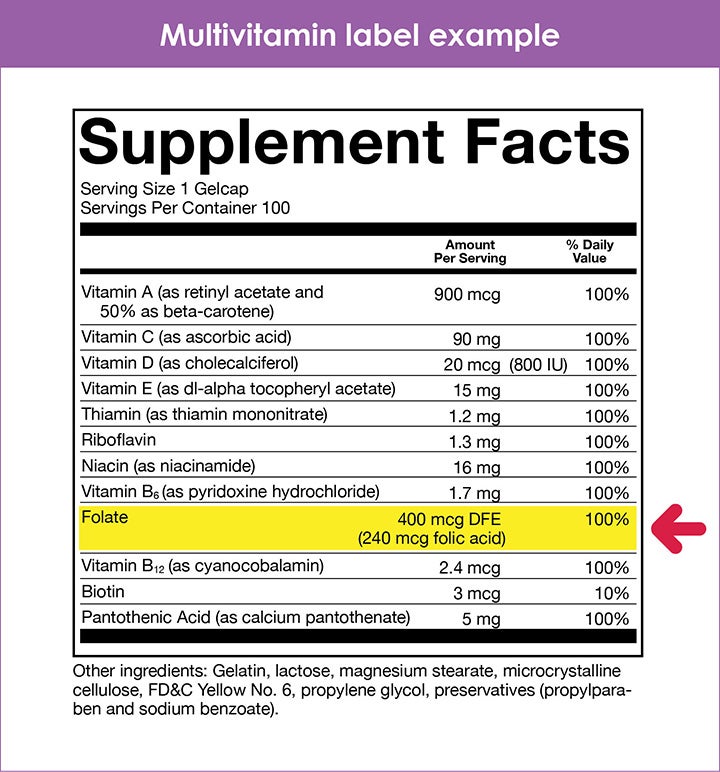
To find out if a vitamin supplement has folic acid in it, check the label (also called supplement facts). The label is usually on the back of the bottle. Look for the word “folate” on the label to see how much folic acid you’re getting. The label tells you this information:
- Serving size. This tells you how much of the product is in one serving. One multivitamin usually is one serving.
- Servings per container. This tells you how many servings are in a multivitamin bottle. For example, if two pills are one serving and the bottle has 30 multivitamins in it, that’s 15 servings.
- Nutrients, like vitamin D, folate and calcium, in each serving
- Daily value (also called DV) of one serving. DV is the amount of a nutrient in a serving. For example, if the DV of folic acid in a multivitamin is 50 percent, that multivitamin gives you 50 percent (half) of the folic acid you need each day.
Vitamin supplement labels now list “mcg DFE of folate,” which stands for dietary folate equivalent. It’s the amount of folate your body absorbs. If a serving has less than 400 mcg DFE of folate, you need more than one serving to get all the folic acid you need each day.
Labels on food products don’t always list the amount of folic acid in the product. Newer food labels that list folic acid will list mcg DFE of folate, just like for vitamin supplements.
If you have an MTHFR variant, can taking folic acid help prevent NTDs in your baby?
Yes. If you have an MTHFR variant, taking 400 mcg of folic acid every day before and during early pregnancy can help prevent NTDS in your baby.
MTHFR stands for methylenetetrahydrofolate reductase. It’s an enzyme (protein) that helps your body break down and use folate. One MTHFR variant (called MTHFRTT or CT genotype) is a change in your body’s MTHFR gene that makes you use folate more slowly than usual. Genes are parts of your body’s cells that store instructions for how your body grows and works. They are inherited (passed from parents to children). MTHFR variants are inherited. If you know you have an MTHFR variant or you think it runs in your family, talk to your provider.
Your provider may want to test you for an MTHFR variant if you have high levels of a substance in your blood called homocysteine. Too much homocysteine in your blood can cause heart conditions, blood clots and stroke. You can find out your homocysteine levels with a blood test. If your level is high, you can have a genetic test to see if you have an MTHFR variant. A genetic test looks for changes in genes that can cause birth defects or other medical conditions.
You may have heard not to take folic acid if you have an MTHFR variant because it can increase your risk of pregnancy complications and your baby having health problems. The Centers for Disease Control and Prevention (also called CDC) recommends that all women take 400 mcg of folic acid every day before and during early pregnancy. If you have an MTHFR variant, talk to your provider.
Additional versions of this article are available in: Arabic, Chinese Simplified, Hindi, and Urdu
Translated documents are courtesy of the employees of CooperSurgical Inc.
Folic Acid Health Action Sheet
More information
Show Your Love Preconception Health
Last reviewed: May 2020